
くも晴れ Vol.12 「楽しい」から、つながりは続いていく。
フラットな関係から組織を動かすコミュニティ
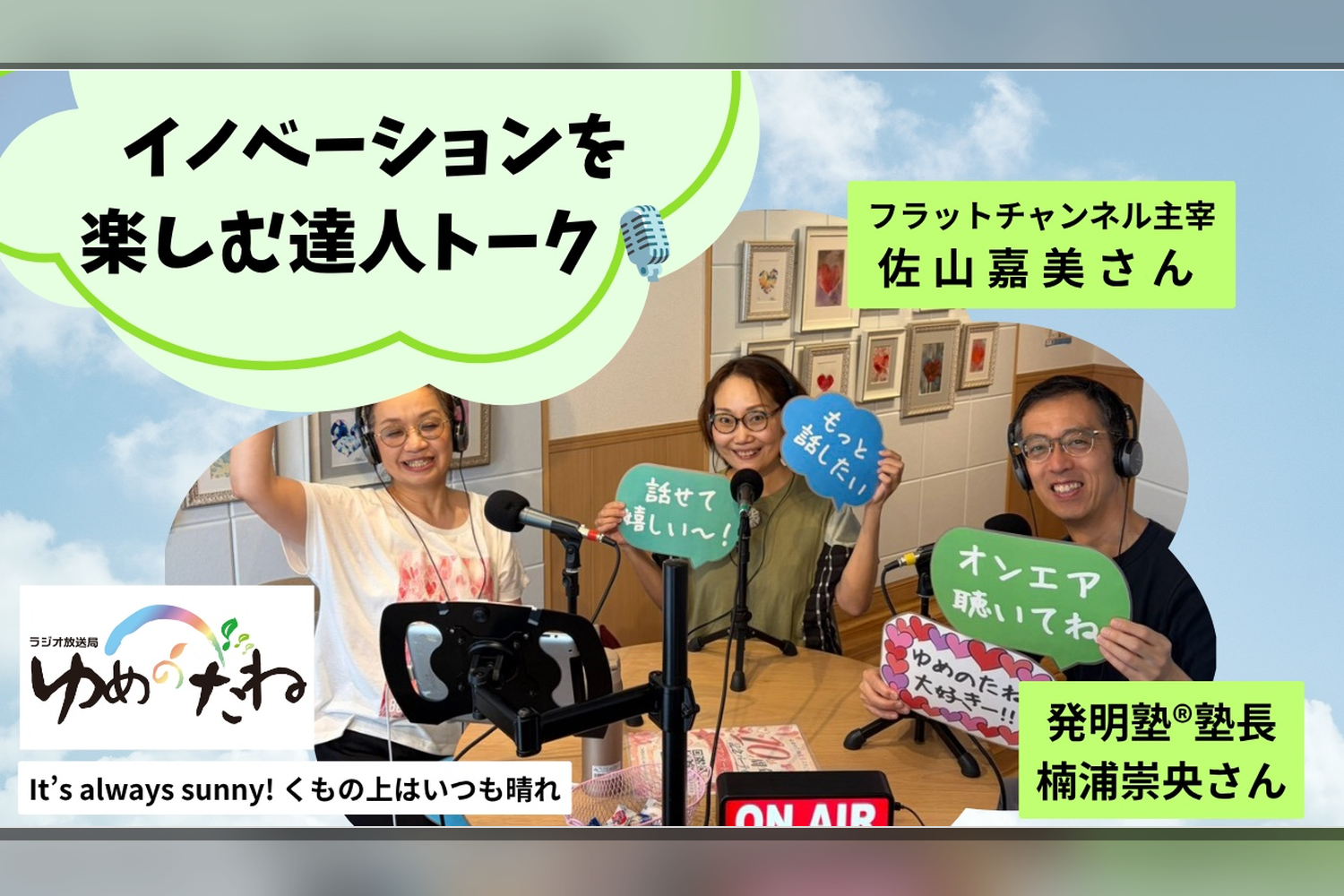
ゲスト:フラットチャンネル主宰 佐山嘉美さん/
発明塾 塾長 楠浦崇央さん
(The English version follows the Japanese text.)
「どんなことがあっても、自分にとっては最高の一日になる。」そんな思いを込めて、Creative Guildのコアメンバーである有賀悦江さんがお届けするラジオ番組「It’s always sunny! くもの上はいつも晴れ」。Vol.12のゲストは、組織の活性化を目指すコミュニティ「フラットチャンネル」を主宰する佐山嘉美さんと、番組ではおなじみの発明塾 塾長・楠浦崇央さんです。今回の対話では、コロナ禍をきっかけに始まった場が、なぜ7年目まで続き、人と組織の関係をひらき続けているのかが語られました。
フラットチャンネルの始まりは、綿密な事業計画ではありませんでした。2020年、突然の在宅勤務によって、同じ会社にいながら人と会えなくなったとき、「組織のみんなをつなげたい」という思いからオンラインの交流が始まります。もともと佐山さんは、同じ事業所で働く人同士が知り合うリアルな活動をしていました。オンラインに切り替えたことで、建物や部署の境界を越え、むしろそれまで出会えなかった人たちへつながりが広がっていきました。
初回には約80人が集まり、当初は週1回ほどのペースで開催。その後は月1回へ移行し、現在はリアルとオンラインを組み合わせながら続いています。佐山さんが目指してきたのは、「組織の人間関係にイノベーションを起こす」ことです。大きな組織では、日常的に関わる相手が上司や同じ部署の人に限られがちです。しかし、自分と相性の合う人、挑戦を応援してくれる人、同じ問題意識を持つ人は、別の部署や拠点にもいるかもしれません。公式のレポートラインだけに依存せず、斜めや横のつながりを持つことで、一人で抱えていた思いや小さな声が、組織を動かす力へ変わっていきます。
フラットチャンネルが大切にしているのは、話を聞いて終わらないことです。登壇者からのインプットに加え、参加者同士の対話やディスカッション、時にはオンライン飲み会まで設け、感じたことを自分の言葉にして交換します。楠浦さんが強く覚えていたのも、自分が話した内容以上に、その後の交流で参加者から受け取った多様な意見でした。登壇者同士が後日集まり、新しい企画や議論へ発展することもあります。知識を一方向に届ける場ではなく、参加者も登壇者も互いに学び、次の関係や実験を生み出す場になっているのです。
長く続くコミュニティには、常連だけで閉じてしまう難しさがあります。フラットチャンネルでは、継続して参加する人、テーマに応じて時々参加する人、初めて来る人が毎回混ざり合います。常連の人たちも新しい参加者に対してオープンで、「一緒にやろう」と自然に迎え入れる。その空気が、初参加の人にも入りやすさをつくっています。5周年の企画には、過去の登壇者約30人を含むおよそ100人が集まりました。積み重ねてきた回数そのものが信用となり、佐山さんが初対面の人にも声をかけ、新しい世界をひらく土台になっています。
もう一つ印象的なのは、主催者である佐山さんが、自分だけで場を盛り上げようとしすぎないことです。楠浦さんは、主催者が前に出すぎると参加者がついていけなくなることもあると指摘し、佐山さんの落ち着いた佇まいと裏方としての姿勢が、フラットチャンネルの入りやすさにつながっていると語ります。一方で、面白い人やテーマに出会えば、すぐに声をかけ、企画へ巻き込んでいく。静かなホスピタリティと大胆な行動力が同居していることが、この場の文化を形づくっています。
佐山さんは、フラットチャンネルの目指す方向を大切にしながらも、活動の最終形を固定していません。その時に出会った人と、その時に面白いと思うテーマを扱い、参加した人の世界が少し広がる場でありたいと考えています。企画書を書いてから始めたわけではなく、目の前の困りごとに向き合い、試し、続けるうちにコミュニティになっていった。この歩みは、コミュニティを立ち上げる最初の条件が、完成された構想ではなく、「何とかしたい」という当事者の思いと、小さく始める行動であることを教えてくれます。
人とつながることは、単に知り合いを増やすことではありません。自分だけが悩んでいるのではないと知り、別の視点や力を受け取り、新しい挑戦へ踏み出せる状態をつくることです。そして、その循環を支えるのは、壮大な理念だけではなく、運営する人も参加する人も「楽しい」と感じられる時間です。楽しさは継続のための飾りではなく、関係を育て、組織を動かすエネルギーなのかもしれません。
Creative Guildでは、このように、楽しさを起点に人と組織の可能性をひらく実践者の物語を共有しています。今いる組織で、話せる相手が限られていると感じるなら、まずは部署や肩書を越えて、一人に声をかけてみる。小さな対話の場をつくり、感じたことを交換してみる。組織の人間関係のイノベーションは、大がかりな制度改革より先に、そんなフラットなつながりから始まるのかもしれません。
関連リンク
When It’s Fun, Connections Keep Growing
Yoshimi Sayama and Takahisa Kusuura on Building a Community That Helps Organizations Move Through Relationships Beyond Hierarchy
Guests: Yoshimi Sayama, Founder of Flat Channel / Takahisa Kusuura, Founder of Hatsumei Juku and CEO of TechnoProducer Inc.
“No matter what happens, each day can still become the best day for you.” With this idea at its heart, Creative Guild core member Yoshie Aruga hosts the radio program It’s Always Sunny! Above the Clouds, the Sun Is Always Shining. The guests for Vol.12 are Yoshimi Sayama, who leads Flat Channel, a community dedicated to energizing organizations, and Takahisa Kusuura, founder of Hatsumei Juku and a familiar guest on the program. Their conversation explores why a gathering that began during the COVID-19 pandemic has continued into its seventh year—and how it keeps opening new relationships within and across organizations.
Flat Channel did not begin with a detailed business plan. In 2020, when employees were suddenly required to work from home and could no longer meet in person, Sayama began organizing online gatherings because she wanted to keep people in the organization connected. Before the pandemic, she had already been creating opportunities for people in the same workplace to meet one another. Moving online removed the limits of buildings and departments, allowing the network to reach people who might otherwise never have met.
Around eighty people joined the first online gathering. The sessions were initially held about once a week, later shifting to a monthly rhythm, and today the community combines in-person and online formats. Sayama describes its mission as creating innovation in organizational relationships. In a large company, everyday interaction can easily remain limited to a manager, a team, or a formal reporting line. Yet the person who understands your idea, shares your concern, or is willing to support your next challenge may work in another department or location. Horizontal and diagonal connections give people more places to think aloud, gather allies, and turn a concern held by one person into energy that can move an organization.
Flat Channel is also designed so that learning does not end when a speaker finishes. Input is followed by participant dialogue, extended discussion, and, especially in the early online period, informal social gatherings. Kusuura remembers the participants’ questions and perspectives from those conversations even more vividly than what he presented himself. Speakers have also been brought back together for later discussions that generate new themes and projects. The community is therefore not a one-way channel for delivering knowledge. It is a place where participants and speakers learn from one another and create the next relationship, question, or experiment.
Long-running communities often face a difficult balance: regular members create continuity, but an inward-looking group can become hard for newcomers to enter. Flat Channel continually mixes people who attend regularly, those who return when a particular theme speaks to them, and first-time participants. Its regular members are open rather than exclusive, welcoming others with an easy sense of “come join us.” That culture gives newcomers permission to participate without first proving that they belong. At the fifth-anniversary gathering, approximately one hundred people took part, including around thirty former speakers. The history of repeated gatherings has become a form of trust that allows Sayama to approach new people and keep expanding the community’s world.
Another important feature is Sayama’s way of leading without dominating the room. Kusuura notes that when an organizer becomes too visibly excited, participants can sometimes struggle to keep up. Sayama’s calm presence and willingness to work behind the scenes make Flat Channel feel approachable. At the same time, when she encounters an interesting person or idea, she acts quickly: she reaches out, invites them in, and turns the connection into a new program. This combination of quiet hospitality and bold initiative has helped shape the community’s culture.
While Sayama values the direction Flat Channel is working toward, she does not define the activity’s ultimate form in advance. She wants it to remain a place where people work with those they meet at the time, explore themes that feel alive, and leave with a slightly wider view of the world. She did not begin by writing a formal proposal for a community. She responded to an immediate need, tried something, and kept learning until a community took shape. Her experience suggests that the first requirement for community building is not a perfect concept. It is a sense of ownership—a genuine desire to improve the situation—followed by a small action that others can join.
Connection is not simply about increasing the number of people we know. It helps us discover that we are not alone in our concerns, receive perspectives and support that were previously out of reach, and find the confidence to begin something new. What sustains that cycle is not only a compelling mission, but also time that feels enjoyable for the people who host and participate. Fun is not decoration added after the serious work. It may be the energy that keeps relationships growing and helps organizations move.
Creative Guild shares stories of practitioners who open new possibilities for people and organizations by beginning with what feels enjoyable and meaningful. If your world at work feels limited to the people already inside your reporting line, consider reaching out to one person beyond your usual circle. Create a small space for conversation and exchange what each of you is seeing. Innovation in organizational relationships may begin before any large-scale reform—with one flat, human connection.

この記事へのコメントはありません。