
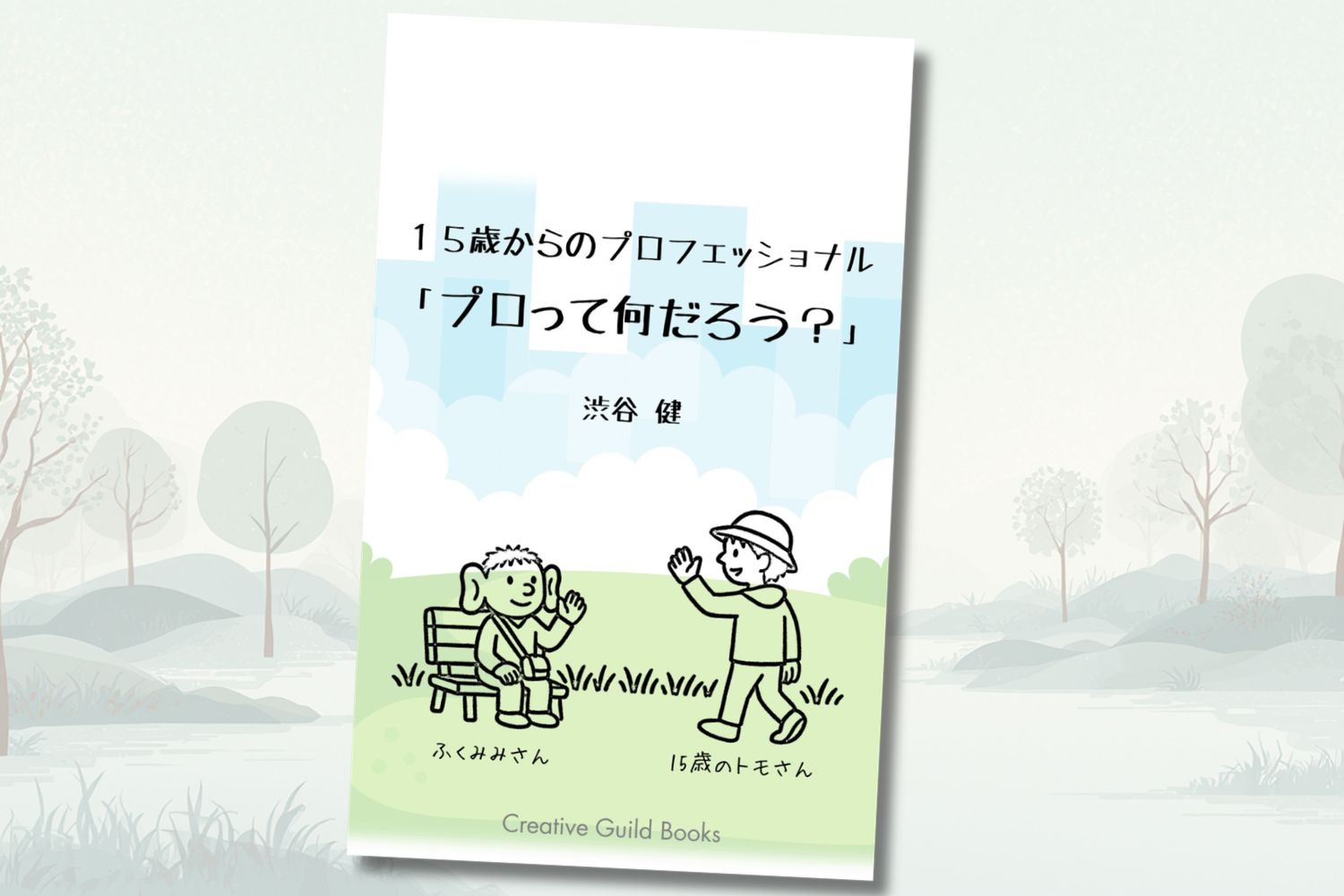
15歳からのプロフェッショナル「プロって何だろう?」
『15歳からのプロフェッショナル「プロって何だろう?」』
ギルドマスター・渋谷 健 著
(The English version follows the Japanese text.)
「プロフェッショナル」という言葉は、仕事やビジネスの場でよく使われます。でも、そもそも“プロ”とは何なのでしょうか。特別な資格を持つ人のことなのか、すごい成果を出す人のことなのか、それとも日々の姿勢や向き合い方に表れるものなのか。今回ご紹介する『15歳からのプロフェッショナル「プロって何だろう?」』(ギルドマスター・渋谷 健 著)は、そんな問いをやさしく考えるための一冊です。
本書では、15歳の「トモさん」と、近所に住む少し不思議で、でもビジネスに詳しいおじさん「ふくみみさん」の対話を通じて、「ビジネスのプロフェッショナル」とは何かをひも解いていきます。難しい専門用語を一方的に解説するのではなく、トモさんの素朴な疑問に、ふくみみさんがゆるやかに答えていく構成なので、学生はもちろん、社会人にとっても自分の働き方を見つめ直すきっかけになります。お茶を飲みながら読めるような、やわらかい対話形式でありながら、仕事や将来を考えるうえで大切な視点が詰まっています。
この本の学びのポイントは、大きく3つあります。
1つ目は、「プロ」を肩書きや職業名ではなく、日々の姿勢として捉え直せること。
2つ目は、ビジネスや働くことを、遠い大人の世界ではなく、自分の生活や未来とつながるものとして考えられること。
3つ目は、問いを持つことの大切さです。
「なぜ働くのか」「誰のために力を使うのか」「自分はどんなふうに成長したいのか」。そうした問いに向き合うことが、プロフェッショナルへの第一歩であることを、本書はやさしく伝えてくれます。
ここで触れられている内容は、中高生のキャリア学習や探究学習、親子で将来について話す時間、若手社会人の研修、チーム内の読書会などに活用できます。また、リーダーシップやプロフェッショナル・マインドを考える入口としてもおすすめです。難しい理論から入るのではなく、身近な問いから考えられるため、世代を超えた対話のきっかけにもなります。
「プロって何だろう?」という問いは、これから働く人にも、すでに働いている人にも、何度でも立ち返る価値のある問いです。経験を重ねたり、時代が変わったりすれば、その捉え方も自然と変わっていくもの。そういった意味では、一度読んで終わりにするのではなく、ふとしたタイミングで読み返し、自分自身の今の働き方や未来と向き合ってみるのもよいかもしれません。
ぜひ、自分自身の未来や働き方と重ねながら読んでみてください。
(日本語版のみ)
Professionalism from Age 15: “What Does It Mean to Be a Pro?”
Takeshi Shibuya, Guild Master of Creative Guild
The word “professional” is often used in the world of work and business. But what does it really mean to be a “pro”? Does it mean having a special qualification? Achieving outstanding results? Or is it something that appears in our everyday attitude and the way we engage with the people and work in front of us?
The book we are introducing this time, Professionalism from Age 15: “What Does It Mean to Be a Pro?” by Guild Master Takeshi Shibuya, is a gentle and accessible invitation to explore that very question.
In this book, the idea of “business professionalism” is unpacked through a dialogue between Tomo-san, a 15-year-old student, and Fukumimi-san, a slightly mysterious neighborhood adult who happens to know quite a lot about business. Rather than explaining difficult concepts in a one-way, textbook-like manner, the book follows Tomo-san’s honest and simple questions, with Fukumimi-san responding in a relaxed and thoughtful way. Because of this conversational style, the book is easy for students to read, while also offering working adults an opportunity to pause and reflect on their own approach to work. It feels light enough to read over a cup of tea, yet it contains important perspectives for thinking about work, business, and the future.
There are three key learning points in this book.
First, it helps readers rethink what it means to be a “pro”—not as a title, occupation, or label, but as an everyday attitude.
Second, it connects business and work not to some distant adult world, but to our own lives, choices, and futures.
Third, it reminds us of the importance of having questions.
Why do we work?
For whom do we use our abilities?
What kind of person do we want to become as we grow?
By gently inviting readers to face these questions, the book shows that becoming a professional begins not with having all the answers, but with learning how to ask meaningful questions.
The ideas explored in this book can be used in many settings: career education and inquiry-based learning for junior high and high school students, conversations between parents and children about the future, training for young professionals, or team-based reading sessions within companies and organizations. It is also a useful entry point for thinking about leadership and professional mindset. Because the book starts from familiar questions rather than abstract theories, it can become a natural starting point for dialogue across generations.
The question “What does it mean to be a pro?” is not only for young people preparing to enter society. It is a question worth returning to again and again, even for those who are already working. As we gain experience, and as the times around us continue to change, our understanding of professionalism naturally changes as well. In that sense, this may not be a book to read only once and put aside. It may be the kind of book to revisit from time to time, using it as a quiet opportunity to reflect on how we work today and how we want to shape our future.
We hope you will read this book while connecting its questions to your own future, your own work, and your own way of living.
Japanese edition only
この記事へのコメントはありません。