
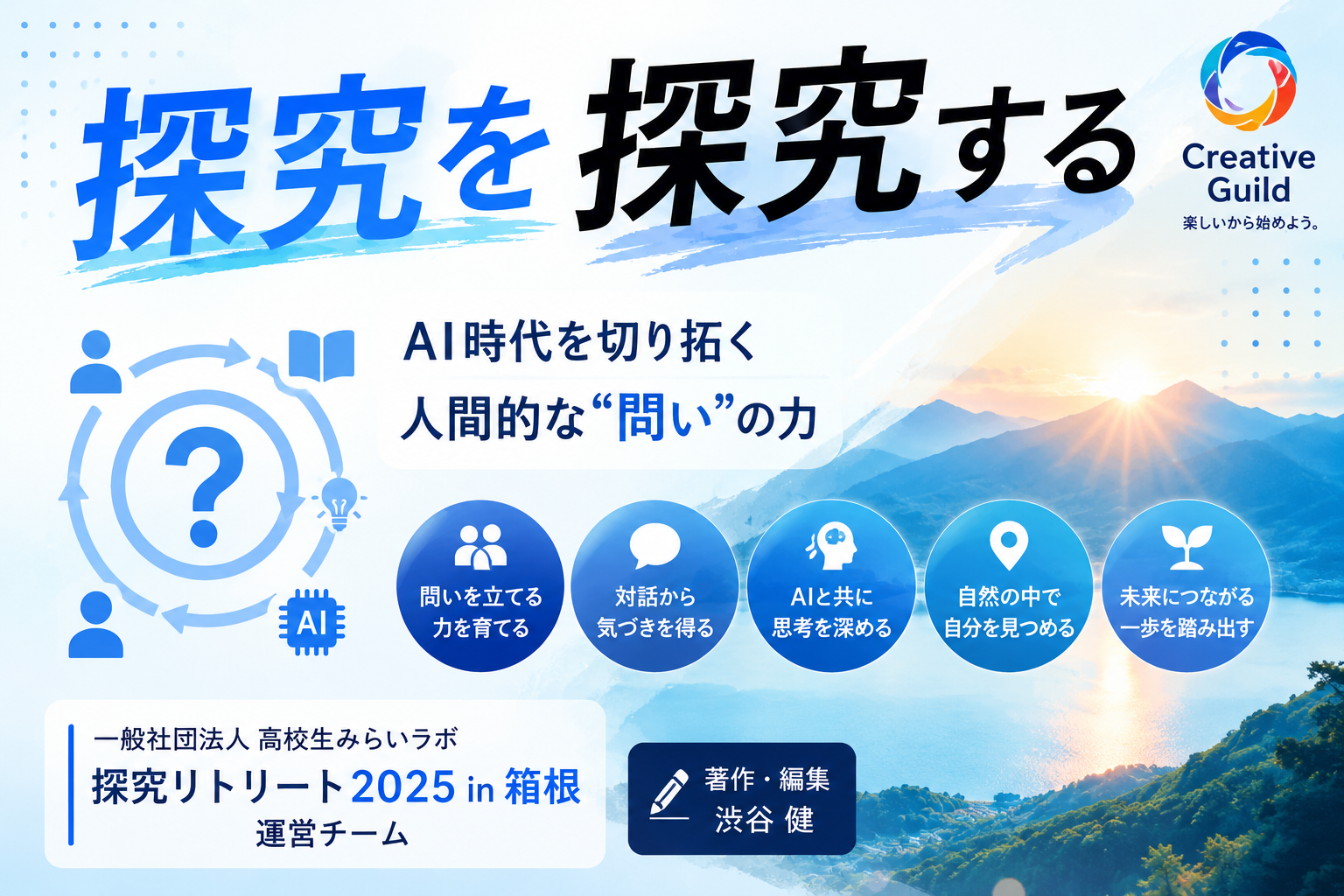
AIが答えを返す時代に、私たちは何を問うのか。『探究を探究する』を刊行しました
AIが答えを返す時代に、私たちは何を問うのか。『探究を探究する』を刊行しました
(The English version follows the Japanese text.)
AIが“答え”らしきものを瞬時に返してくれる時代。私たち人間に、これから本当に必要な力とは何でしょうか。
Creative Guild Booksから刊行した『探究を探究する―AI時代を切り拓く人間的な“問い”の力』は、その問いに正面から向き合う一冊です。本書が大切にするのは、与えられた正解を覚えることではなく、自分の内側に生まれた「なぜ?」を起点に、考え、試し、振り返り、自分なりの答えを創っていくこと。探究を、学校の授業だけに限られた特別な活動ではなく、誰もが日常や仕事の中で実践できる営みとして捉え直します。
第1部「探究を知る」では、探究の意味や歴史を入り口に、経験学習、知識創造、メタ認知、成人発達といった理論を、身近な例とともに紹介します。さらに、世界と日本の探究教育、問いの立て方、評価や制度上の課題までを整理。中高生にも読みやすく、教育に関わる方や企業の人材育成担当者にも役立つ内容です。
第2部「探究を実践する」の舞台は、一般社団法人高校生みらいラボが実施した「探究リトリート2025 in 箱根」です。高校生、大学生、社会人、教育関係者が世代や立場を越えて生活を共にし、問いを持ち寄り、対話し、試行錯誤した経験をひも解きます。
そこから浮かび上がったのは、自然や沈黙が生む「余白」、価値観を揺さぶる体験、完璧さよりも必死に伝える姿勢、感性と対話から問いが自立していく過程、そしてAIが振り返りを支え、学びを物語として残す可能性でした。
第3部「探究を活かす」では、探究を「問い→試行→振り返り→更新」の循環として捉え、個人の自己効力感やウェルビーイング、組織のエンゲージメントやイノベーション、地域や社会の共創へとつなげます。
AIは答えを代わりに決める存在ではなく、人間の問いを深め、学びを継続させる伴走者です。その力を活かす鍵も、何を目的に、どんな問いを投げかけるかという人間のマインドセットにあります。
本書は、高校生みらいラボの知見と、箱根で生まれた参加者との対話や成果物をもとに、ファシリテーターの小林拓真さん、著作・編集を担ったCreative Guildの渋谷健が形にしました。探究教育の解説書であると同時に、AI時代の学び方、生き方、働き方を考えるための実践書です。学生、保護者、教員、経営者、組織づくりに関わる方、そして「このままでよいのだろうか」という小さな違和感を抱くすべての方に読んでいただきたい内容です。
本書が目指すのは、個人の探究を一度きりの体験で終わらせず、仲間との対話を通じて社会の文化へ育てていくことです。学校、企業、地域、家庭など、それぞれの立場から始められる具体的なアクションも紹介しています。
未来を動かす探究は、壮大なテーマからではなく、今日ふと感じた小さな「なんで?」から始まります。無理なく、自然体で、楽しさを軸に。あなた自身の問いを見つける旅を、この一冊から始めてみませんか。
本書はペーパーバック版とKindle版でお読みいただけます。
In an Age When AI Provides Answers, What Should We Ask? We Have Published Inquiring into Inquiry
AI can now return something resembling an answer in an instant. What abilities will we humans truly need from here on?
Creative Guild Books has published Inquiring into Inquiry: The Human Power of Questions to Navigate the Age of AI, a book that confronts this question directly. Rather than memorizing answers supplied by others, it emphasizes starting from the “why?” that arises within us, then thinking, experimenting, reflecting, and creating answers of our own. It reframes inquiry not as a special activity confined to school lessons, but as something anyone can practice in daily life and at work.
Part One, “Understanding Inquiry,” begins with the meaning and history of inquiry and introduces theories such as experiential learning, knowledge creation, metacognition, and adult development through familiar examples. It also examines inquiry education in Japan and around the world, ways to formulate questions, and challenges related to assessment and educational systems. The content is accessible to junior-high and high-school students while also offering value to educators and corporate learning and development professionals.
Part Two, “Practicing Inquiry,” centers on Inquiry Retreat 2025 in Hakone, organized by the general incorporated association High School Mirai Lab. High-school students, university students, working adults, and educators lived together across generations and roles, bringing their questions into dialogue and learning through trial and error.
What emerged from the experience included the space created by nature and silence, encounters that unsettled familiar values, the importance of striving to communicate rather than seeking perfection, the process through which questions gained a life of their own through sensitivity and dialogue, and the possibility that AI can support reflection and preserve learning as a story.
Part Three, “Applying Inquiry,” understands inquiry as a cycle of questioning, experimenting, reflecting, and updating. It connects this cycle to personal self-efficacy and well-being, organizational engagement and innovation, and co-creation in communities and society.
AI is not there to decide answers on our behalf. It can accompany us by deepening human questions and helping learning continue. The key to using that power lies in the human mindset: the purpose we choose and the questions we ask.
Drawing on the knowledge of High School Mirai Lab as well as the dialogue and work created by participants in Hakone, the book was shaped by facilitator Takuma Kobayashi and Takeshi Shibuya of Creative Guild, who handled the writing and editing. It is both an introduction to inquiry-based education and a practical guide for thinking about how we learn, live, and work in the age of AI. It is intended for students, parents, teachers, business leaders, people involved in building organizations, and anyone who carries the quiet sense that things may need to change.
The book seeks to ensure that personal inquiry does not end as a one-time experience, but grows into part of society’s culture through dialogue with others. It also presents concrete actions that readers can begin from their own positions in schools, companies, communities, and families.
Inquiry that moves the future does not begin with a grand theme. It begins with a small “why?” that catches your attention today. Without forcing it, and with enjoyment as your compass, why not begin the journey of discovering your own questions with this book?
The book is available in paperback and Kindle editions.

この記事へのコメントはありません。